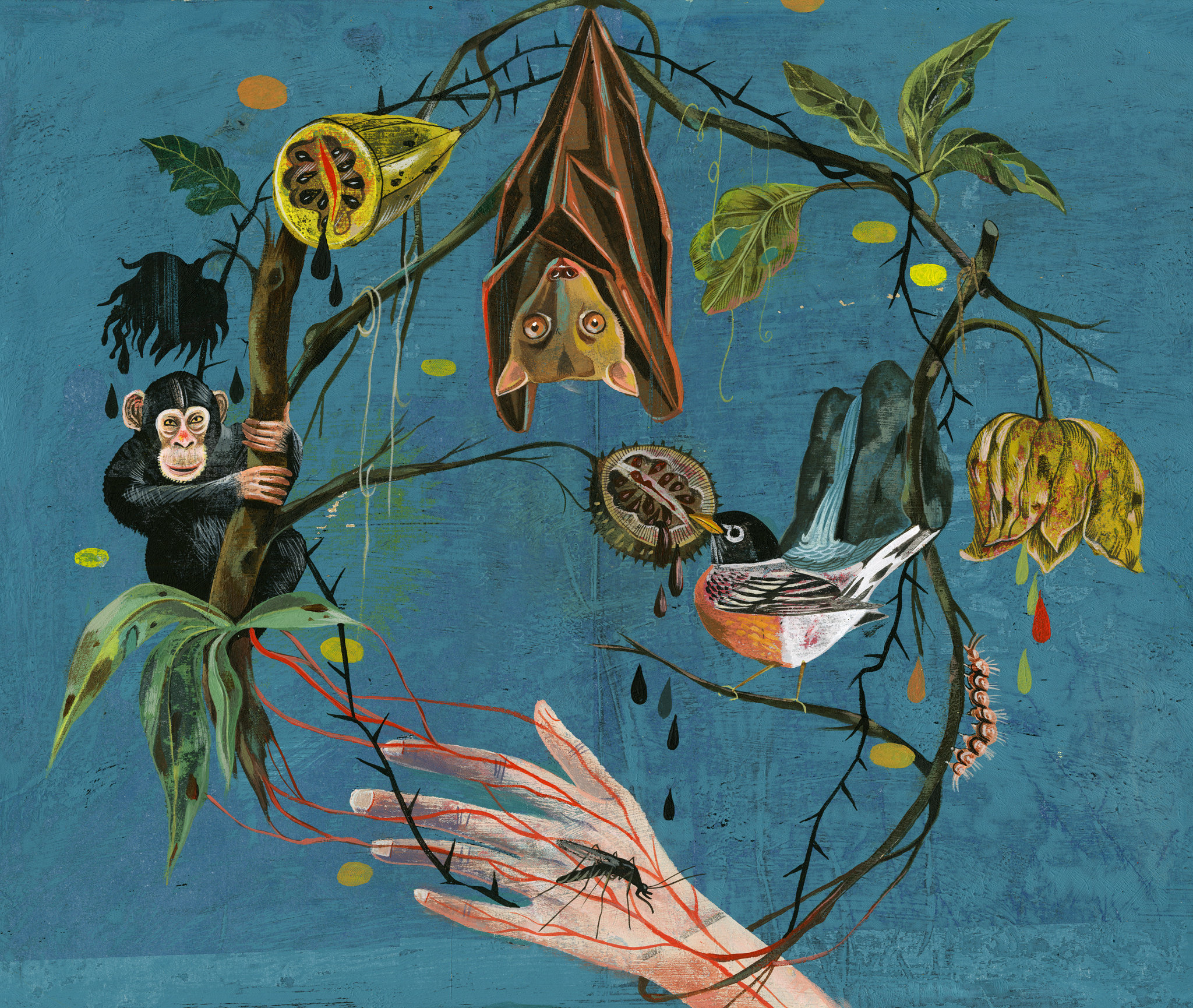
Disease ecology is the study of host–pathogen interactions within the context of their environment and evolution, and is deeply shaped by social, political, and historical forces. Emerging wildlife and zoonotic diseases have global and profound impacts, including economic and agricultural disruption, declines in wildlife populations, ecological instability, and loss of human life. These disease dynamics are governed not only by species interactions and abiotic conditions, but also by land use, colonial histories, systems of power, and unequal exposure to risk.
This course is grounded in a One Health framework, which recognizes the inseparable connections between human health, animal health, and environmental health. We will examine how globalization, climate change, agriculture, and structural inequalities interact to shape disease emergence and spread. Through case studies of vector-borne human pathogens and wildlife diseases, we will explore how race, power, and non-neutral scientific practices influence whose lives are protected, whose knowledge is centered, and whose suffering is normalized within disease ecology.
By integrating ecological theory and evolutionary principles with historical and contemporary perspectives on wealth inequality, colonialism, and environmental justice, this course is designed to challenge the idea that scientific knowledge is neutral or universal, and instead situates disease ecology within broader systems of power and responsibility.
This course is grounded in a One Health framework, which recognizes the inseparable connections between human health, animal health, and environmental health. We will examine how globalization, climate change, agriculture, and structural inequalities interact to shape disease emergence and spread. Through case studies of vector-borne human pathogens and wildlife diseases, we will explore how race, power, and non-neutral scientific practices influence whose lives are protected, whose knowledge is centered, and whose suffering is normalized within disease ecology.
By integrating ecological theory and evolutionary principles with historical and contemporary perspectives on wealth inequality, colonialism, and environmental justice, this course is designed to challenge the idea that scientific knowledge is neutral or universal, and instead situates disease ecology within broader systems of power and responsibility.
- Teacher: Jennifer VanWyk
- Teacher: Jenny VanWyk