This course introduces students to basic mechanisms of diatonic harmony. Through analysis, performance, and composition, we will build a solid working understanding of basic principles of melody, harmony, and form common in many musical traditions that we consume in our everyday lives.
In the first half of the course, we explore composition in 4-part polyphonic texture with and without modulation. In the second half, we explore modes as storytelling devices. Throughout the semester, we study different ways to build a larger coherent structure from smaller melodic motifs and harmonic progressions. Student interested in taking this course need to take the diagnostic evaluation in the first
class. The instructor’s permission will be given based on the result of the diagnostic evaluation. Students’ musical experiences will be taken into consideration, but performance skills do not warrant music theory competence in most cases.
Sometimes, the instructor’s permission is given on the condition that the student takes responsibilities to do any necessary makeup. If their progress is not meeting the expectation of this course by the time of midterm evaluation and/ or it is obvious that students are not making any efforts, they may be asked to consider withdrawing from the course. This policy also applies to students who were given the
instructor’s permission with no additional conditions.
Goal:
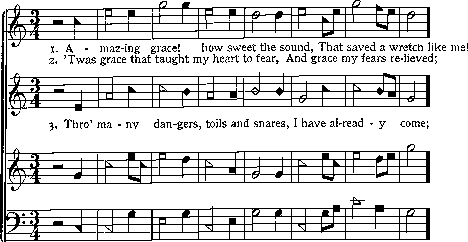
This course is designed to teach diatonic four-part voice leading and modal schemas as functional analytical, compositional, and storytelling tools.
The course will be taught in a workshop style, inviting students’ active participation in collective analysis, problem solving, and occasional performance. This course promotes integrated multisensory approaches to music (visual, aural, tactile) through these activities.
Although composing music is an integral element of the curriculum, this course is NOT a composition seminar. Our goal is to learn a skill set applicable in any “authentic” contexts and a solid foundation necessary for further development.
This requires students to understand rules of the game well and learn to work with/ around them. In the second half of the course, we explore how to set our own rules of the game (sonic worldbuilding) and learn what entails effective rule-setting.
The skill set includes sight-reading, aural, and notation skills (both hand written and software assisted).
In the first half of the course, we explore composition in 4-part polyphonic texture with and without modulation. In the second half, we explore modes as storytelling devices. Throughout the semester, we study different ways to build a larger coherent structure from smaller melodic motifs and harmonic progressions. Student interested in taking this course need to take the diagnostic evaluation in the first
class. The instructor’s permission will be given based on the result of the diagnostic evaluation. Students’ musical experiences will be taken into consideration, but performance skills do not warrant music theory competence in most cases.
Sometimes, the instructor’s permission is given on the condition that the student takes responsibilities to do any necessary makeup. If their progress is not meeting the expectation of this course by the time of midterm evaluation and/ or it is obvious that students are not making any efforts, they may be asked to consider withdrawing from the course. This policy also applies to students who were given the
instructor’s permission with no additional conditions.
Goal:
This course is designed to teach diatonic four-part voice leading and modal schemas as functional analytical, compositional, and storytelling tools.
The course will be taught in a workshop style, inviting students’ active participation in collective analysis, problem solving, and occasional performance. This course promotes integrated multisensory approaches to music (visual, aural, tactile) through these activities.
Although composing music is an integral element of the curriculum, this course is NOT a composition seminar. Our goal is to learn a skill set applicable in any “authentic” contexts and a solid foundation necessary for further development.
This requires students to understand rules of the game well and learn to work with/ around them. In the second half of the course, we explore how to set our own rules of the game (sonic worldbuilding) and learn what entails effective rule-setting.
The skill set includes sight-reading, aural, and notation skills (both hand written and software assisted).
- Teacher: Junko Oba